
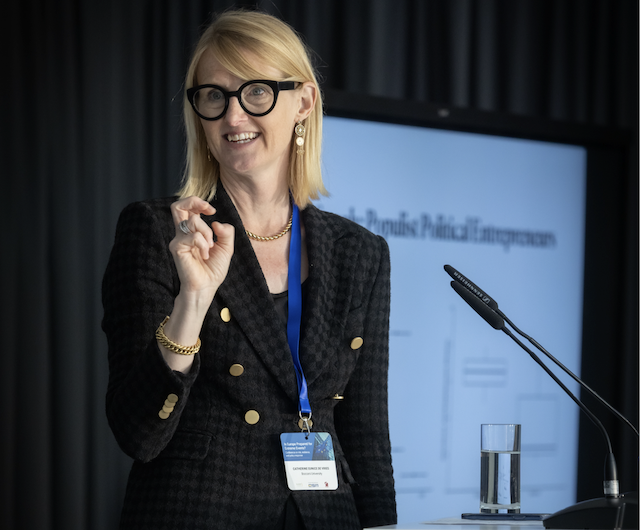
Catherine is Vice Dean and Professor of Political Science at the School of Politics, Economics and Global Affairs (SPEGA) at IE University in Madrid. At SPEGa she also chairs the department of political science. Catherine holds an Honorary Professorship at Queen’s University Belfast, and is an associate member at Nuffield College, the University of Oxford. She was elected to the Leopoldina, the German Academy of Sciences. Previously, Catherine held professorships at Bocconi University, Oxford University, Free University (VU) Amsterdam and visiting posts at UCLA. Next to her academic activities, Catherine serves on the Dutch Advisory Council on Foreign Affairs’ Committee on European Integration, chairs the Advisory Council of the Wissenschaftszentrum Berlin für Sozialforschung, and serves on several university boards. In 2013, she was selected a Young Global Leader in the World Economic Forum for her service to society.
In her research, Catherine focuses on the interplay between international cooperation and domestic politics. Her work contributes to our understanding of European politics, the rise of populism and the far right, political polarization and fragmentation, public service provision and corruption. Her recent research, funded through the European Research Council, focuses on the politics of public service provision. A core insight from this project has revealed how the far right exploits voter discontent with crumbling public service provision.
Her work has appeared in leading political science and international relation journals, such as the American Political Science Review, International Organization, Annual Review of Political Science, and the Journal of Politics. She received several prestigious awards and grants, such as European Research Council consolidator grant and book and paper prizes from American Political Science Association, Midwest Political Science Association and European Union Studies Association.
Throughout her career, Catherine has published several books. Her first book Euroscepticism and the Future of European Integration published with Oxford University Press in 2018 received the European Union Studies Association (EUSA) Best Book in EU Studies Award in 2019 and was listed in the top-5 books on Europe’s future by the Financial Times. The book develops a benchmark theory of public opinion towards European integration and suggests that people’s views about Europe are intrinsically linked to the national benchmarks employed. The praise for the book by Professor Matthew Gabel from the University of Washington at St Louis highlights that “[t]his is a superbly written, wonderfully perceptive, book, which will move the posts in the field of public opinion” and its “findings are sure to provide valuable grist for the mill for politicians, EU officials, and journalist interested in making sense of, addressing, and perhaps even exploiting contemporary public resistance to the EU.”
In 2020, she published her second book Political Entrepreneurs: The Rise of Challenger Parties in Europe, co-authored with Sara B. Hobolt, with Princeton University Press. Drawing analogies with how firms compete, this book demonstrates that political change is as much about the ability of challenger parties to innovate as it is about the inability of dominant parties to respond. Delving into strategies of dominance versus innovation, the book explains why European party systems have remained stable for decades, but also why they are now increasingly under strain. The praise for the book by Professor Pippa Norris from Harvard University highlights that “supported by a formidable body of empirical evidence, Political Entrepreneurs provides fresh theoretical insights into the causes and consequences of this phenomenon. An invaluable contribution to understanding how parties compete in contemporary democracies.”
In 2021, Catherine and her co-authors Sara B. Hobolt, Sven-Oliver Proksch and Jonathan Slapin published a textbook Foundations of European Politics with Oxford University Press. It offers an accessible introduction to European politics using a coherent comparative and analytical framework that can be used to understand both national and EU-level policy-making in Europe. The praise for the textbook by Michael Laver from New York University states that: “Authoritative and informed, yet accessible, this excellent introduction to European politics deftly interweaves theory and data. Designed to make readers think for themselves, this book offers a fine introduction to political science more generally, from respected authors who really know their stuff.”
Catherine’s her fourth book, Money Flows: The Political Consequences of Migrant Remittances published with Oxford University Press, co-authored with David Doyle, Katerina Tertytchnaya and Hector Solaz, received the American Political Science Association (APSA) Migration and Citizenship section Best Book Award. This book highlights the unintended, and even unexpected political consequences of remittance flows. It focuses on how remittances shape the relationship between citizens and their governments, and show that far from being an exclusively international risk-sharing mechanism, remittances can also compromise rudimentary accountability mechanisms in the developing world.
Catherine serves the editorial board of several journals, like Comparative Political Studies, Journal of Politics and Political Science Research and Methods for example. She is also a co-editor of a Cambridge Elements Series on European Politics.
Next to teaching and research, Catherine tries to contribute to public debate through advice and commentary based on her research findings. She is a columnist for Het Financieele Dagblad and regular contributor to de De Groene Amsterdammer. Together with Isabell Hoffmann of the Bertelsmann Foundation, Catherine co-founded the platform eupinions. Through the eupinions platform, quarterly data is collected, analysed and commented to establish how the European public thinks about current political issues. Check out the eupinions website for more information. She has also contributed to general interest magazines like Foreign Affairs or New Statesmen or newspapers like the Financial Times or Guardian.